
FREQUENTLY ASKED QUESTIONS
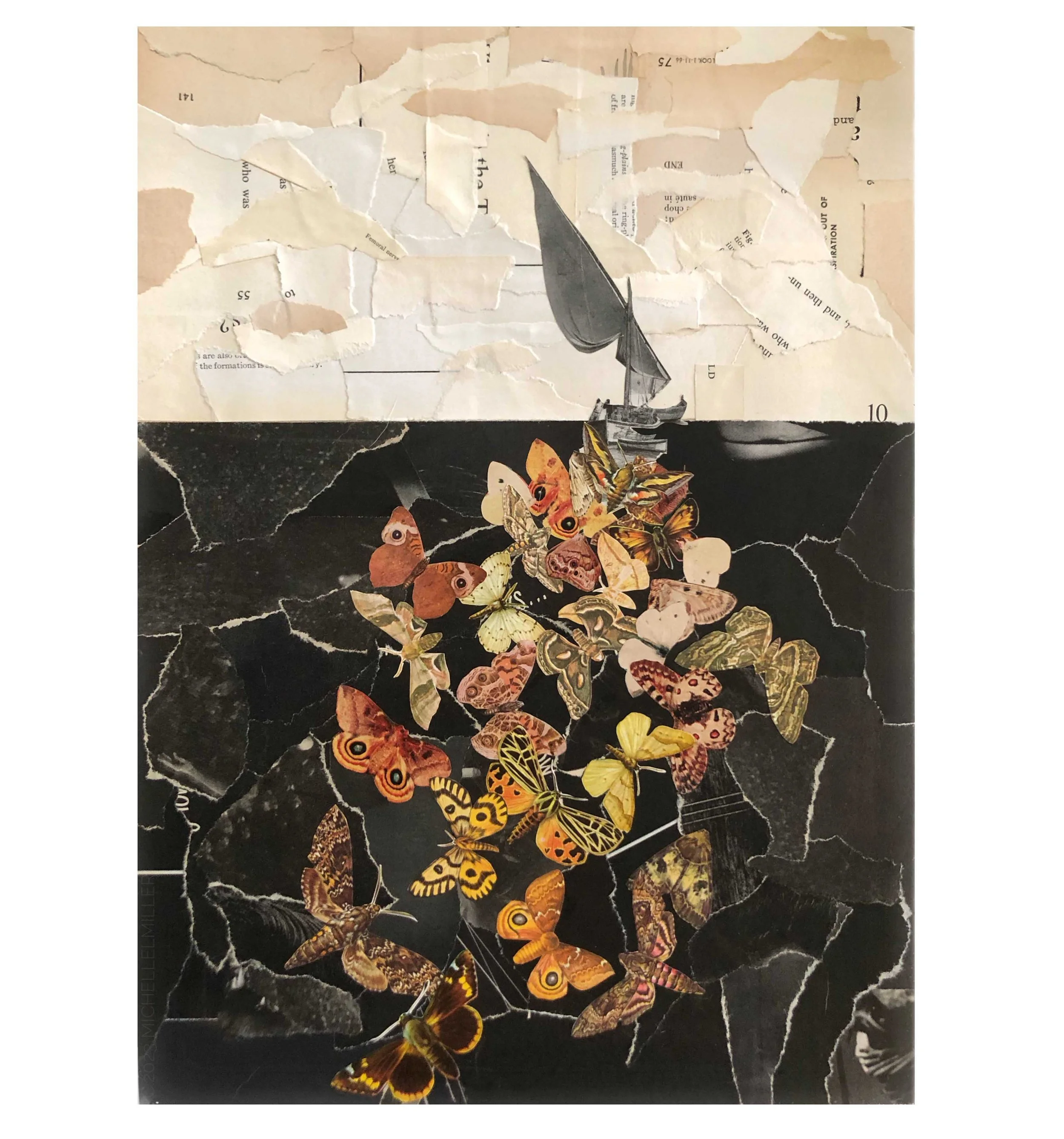
Michelle L Miller, Just Underneath the Surface
-
by Laurie Kanyer
In the mid-1980s, while on staff at a community college, my department chair asked if I would be willing to teach a high school course in child psychology. The college had a partnership with the local school district, and they needed an expert to fill in a few sections. It happened to be at the high school from which I had graduated and so I jumped at the opportunity.
My enthusiasm for the opportunity waned a bit when I discovered the class had no textbook or curriculum. Class was to begin in five (5) days. With no time to spare, I formed a syllabus and gathered all of the magazines I could find. My thought was the students could use collage-making to further their learnings on the topics I planned to teach.
The Method was Developed by Accident
I developed a preset daily class format knowing the material we would cover would touch on sensitive topics. I decided to use a predictable format as a foundation to explore potent and tender materials. My suspicion was that those who took this class were curious on a personal level as well as academic about the emotional, psychological world of humans, namely children. I knew that if they experienced a predictable routine in the class it would ease their spirits, allowing them to explore and consider the lessons. This predictable format is the exact model you will experience in the books. Following this preset pattern, I would ask my students at the end of every class period to reflect on the lesson of the day. What did they learn? How did they feel? What did they think about the topic? For their answer, they could choose to either use collage-making or write a brief reflection paper. Most did both, but collage-making was preferred by the majority. The course was an elective and many of the teens had learning hardships, some were in chemical dependency recovery, and others were overachievers who needed less schoolwork. Because of this mix, I wanted to avoid assigning out-of-class homework.
One thing all of these students had in common was they had too much on their plate, with extra-curricular activities, part-time jobs, or difficulties at home. I simply devised a quick and effective method for them to document their learnings in class and to get their thoughts and feelings out as it related to the daily lessons. I wanted to decrease their load. I was just nine (9) years out of high school myself, so I could remember, and empathized.
Surprising Results and Outcomes Emerged — There Were Impressive Transformations
When it came time for tests a majority of the students achieved above a B, and no one failed. All of the students passed the course with a grade C or higher. Compliance with the daily reflection activity was one-hundred percent. Everyone took part. Students began to bring magazines to contribute to the source material pile. Attendance at the class, which was held early in the day, was high. Their grades in my class were higher than in other courses they took part in.
The difference? The use of collage-making to mark their learnings, process their ideas, and express their emotions and feelings. Some years later, I learned many of those students would become therapists, medical professionals, educators, and school principals. Some became parents in short order.
Using Collage-Making with Adults
Later, I worked with pregnant and parenting adults who were experiencing poverty and other associated hardships. They were receiving government-backed financial aid grants. They attended my groups three times a week, two hours each session, and took part in individual counseling sessions with me outside of the group setting. I also offered case management, which allowed me to go with them to appointments and teach them skills to access the things they needed. It was an intense program. Much like the high school class, each of the in-group sessions followed a preset format consisting of the exact same components each time we met. These sessions were two hours long, so I was able to expand the model. The format for the first hour consisted of an opening welcome, reviewing of set ground rules, a thought-provoking introductory question, and then a time of them sharing their individual celebrations and concerns. We tapped into the wisdom of the group using Suggestion Circle and other tools to help resolve their concerns.
In the second hour, I made a short presentation, just as I did in the high school classroom. This presentation consisted of an opening quote, a mini-lesson, and a content roundup of the major points of the lesson. They then used collage-making as a way to reflect, contemplate, and document their learnings. We finished each session with a closing quote. I rotated between having the parents make a collage in response to the lesson (as my high school students did) or more often I provided a step-by-step, guided collage-making Exercise-Experience related to the topic (like those featured in the books). There was a time for sharing their collage if they were comfortable. We ended with them expressing any resentment or appreciations they had of our time together. I frequently added other tools aimed to assist them. The Takeaway Action Tools featured at the back of each of the books are the exact tools I used.
Collage-making in this setting was instrumental, as many of the women had learning challenges and most of their responses needed to be kept confidential. I had written a book on childhood grief and loss, where I documented the value of modulating and pacing the hormonal energy of the brain connected to grief. I knew collage-making would help them. With collage-making they could communicate their ideas and reduce their energetic-emotional stress.
The Outcome was Remarkable
The state of Washington did an annual review of their goals and intended outcomes for the programs they fund, with the overarching goal of parents securing employment. Their statewide study of like- programs aimed to gauge the effectiveness of these programs. The study showed my program had a 19% success rate, compared to 2% for other programs. While these numbers are shockingly low, as there are many barriers for this demographic to obtain employment, it is clear my program was more effective. Surprising results and outcomes once again emerged. There were impressive transformations.
The difference? Once more, the answer was the use of collage-making to mark their learnings and process their ideas, to express their emotions and feelings. Years later, many of the women have on-going employment, many went on to complete high school, some went on to college. Their interpersonal skills improved, and their self-efficacy was enhanced.
Collage-Making, as Opposed to Making a Fine Art Collage
It is important to mention that I used the process of collage-making in my instructional and therapeutic background. By collage-making, I mean cutting, pasting, tearing paper and then gluing it to another piece of paper. We were not making “fine art” collages. My theory was that the act and process of collage-making offered unique benefits that would help, heal, and transform many emotional, cognitive, communication, and behavioral aspects for my clients. I was not having them make fine art collages, which could elicit comparison and critique, or harken back to earlier life experiences of making art. While likely connected in both form and function, this was not intentional, traditional, art therapy.
Decades of Using Collage-Making with Amazing Results
I spent decades facilitating the use of collage-making as a tool to explore tender and potent topics related to being a human. In every case it provided a way to ease the magnitude of those tender topics, which include emotions, feelings, communication hardships, gaining cooperation with kids and adults and more.
The students and clients did not have to worry about spelling and penmanship. They could express their thoughts, document their learnings, and mark their feelings on a topic with an image, rather than in writing. Often what they made was beautiful, eloquent, and authentic.
Due to the limited time in the classroom or group counseling session, the resulting collages often had an immediate, focused feel and look to them. The elements were chosen with thought and intention. They had a visual tone of force, power, and resolute knowing. The idea was to get their point across directly within the time restraints. Many had a visual feel similar to the art of noted collagist Fred Free.
Using Collage-Making Myself
I later took up collage-making when a sudden emotional jolt occurred in my own life. I had made collage most of my life, in the form of scrapbooks, however making a fully-formed collage in response to a “small t” trauma was a new application for me. I have made thousands of them since that time. I use collage-making now as an intentional self-care tool to help, heal, and transform my life. Eventually, I reached out to the international collage world to collaborate and look for ways to amplify and magnify collage in art history.
Collage Collection Amplifying Fine Art Collage
My husband Doug and I have been art collectors since the late 1970s. For a majority of that time, we collected the works of artists from our local area (see KanyerArtCollection.com). That shifted gears in 2016. Having fallen in love with the medium of collage, we committed to collecting collage exclusively. The goal was to uplift the medium from a fine art perspective and expand it in art history. We began to buy collages internationally. I had many conversations with collagists from all over the world. I began to share what I knew about collage-making as a helping, healing, and transformational tool.
Conversations with Collagists Internationally
Perhaps because they learned I was a counselor and educator, collagists have quite naturally shared with me how and when they came to make collage. Almost to a person, it appeared they came to make collages after or during a time of great life strain. A measurable, challenging “something” had taken place in their life and they spontaneously seemed to take to cutting or tearing magazines, and then gluing paper-to-paper.
Some were established fine artists, who had attended art school. Others were serious hobbyists, who found they had some talent and ended up making collage as a vocation, rather than simply for fun. What they had in common was turning to collage-making during a measurable crisis or serious life event. To confirm this observation, I conducted a study in 2020. I asked participants this question: “Was there a “something”, a person, place, event, circumstance, or situation that caused you to begin to collage?” Of the 80 people who took part in the study, 78 reported that a significant life event, a “something”, ignited them to begin to use collage-making.
Curiosity About How Collage-Making Helps, Heals, Encourages, and Transforms
Eventually the artists in the Collection were very curious about what I knew about how collage-making helps, heals, and transforms lives. One artist in-particular, Andrea Burgay, urged me to write a book. Having written books in the past I was very hesitant, as book-writing is laborious and is complicated by my being dyslexic.
She suggested I start by making a simple list. I did so, and by the end of the day I had 55 ways collage-making helps, heals, and transforms. Later another 70 ways came forth. That list became the GEMs featured in the book Collage Care, Transforming Emotions, Feelings and Life Experiences with Collage (2021). Essentially it documented, with empirical evidence, my theory that collage-making, when used as an intervention, helps, heals and transforms. Indeed, many of the people in the study group said, “Collage saved my life.”
A Book was Born
During the COVID-19 pandemic I set out to actually write a book. It was to consist of a collection of Exercise-Experiences that were based on the exact format and model from my classes, individual counseling sessions, and groups. The collagist and painter CP Harrison joined this project and tested all the sample Exercise-Experiences I wrote. Harrison is not only an artist, but a counselor for the American Cancer Society. Many of his fine art collages are featured in the books.
That plan got side-tracked due to the pandemic. I knew collage helps, heals, encourages, and transforms. I decided that I would first publish the evidence, the GEMs, on how collage helps. The Exercise-Experiences would have to wait. My hope was that collagists, in reading the GEMs, would continue to keep using collage-making during this world-wide crisis. I believed if they kept using collage-making they would be well, or better off, than if they did not make collages. And I hoped to convince other people who found themselves in crisis due to COVID to start to use collage-making.
Collage Care: The Method™
Once the evidence (the 125 GEMs) of how collage helps was published, I returned to editing the Exercise-Experiences. In all, I have written over 100 Exercise-Experiences (EEs) that have followed the same method and model I used for decades. The first Collage Care: The Method™ book features the basic thirty (30) EEs. My husband Doug joined in this book project as the editor, and we continued with the design team of JuSt Design. There are now over eighty (80) EEs one can use between all the books.
Collage Care: The Method™ Model
My son Wyatt Kanyer is also a therapist. After he helped to edit Collage Care: Transforming Emotions and Life Experiences with Collage, he pointed out that I had created a model-method using a specific intervention, collage-making. This had not occurred to me, but it was true.
Out of necessity I had accidentally developed a theory which I had tested and practiced. I developed and proved the model. I had studied the impact of the theory and used the model for decades. And in 2021, I published the findings of decades of study in Collage Care, Transforming Emotions, Feelings and Life Experiences with Collage. He encouraged me to document the theory and model, which I did, and I now call it Collage Care: The Method™.
International Research Project
Beginning in spring 2023 an extensive research study of Collage Care: The Method™ group facilitation process was launched. It included professionals and peer group leaders using a draft version of the Collage Care: The Method Facilitators’ Guidebook. The research was being conducted in Oxford, Liverpool, Dorsett and Plymouth, England as well as Italy, The Netherlands, Sweden, Texas, Washington DC, New York, and Washington. Wyatt Kanyer, MA, LCSW of Tucson, Arizona offered consultation to the project. The objective was to study the viability of offering a facilitator development course of study to be able to offer Collage Care: The Method™ in group settings. The study proved that Collage Care: The Method™ could be offered in a group setting beyond its original application.
The researchers who took part in this project are listed below, in alphabetical order:
Sonia Boué, MSc/CQSW, Diploma in Art Therapy, Multiform Artist, Writer and Consultant for Neurodiversity in the arts, Oxford, England
Ariane Buheiry, Collage Artist, Manziana, Italy
Sara Silvia Ferrucci, Collage Artist, Art Counselor, Rome, Italy
Simone Löhndorf, Ph.D., Collagist, Cognitive Linguist, Lund, Sweden,
Michelle L. Miller, MS, Licensed and Board-Certified Art Therapist, Rochester, New York, USA
Miranda Millward, MA, Collage Artist, Arts Learning and Engagement Specialist, Oxford, England
Michelle Monet, RN, Certified Nurse Coach, Selah, Washington, USA
Jennifer Penick, MA, Artist in Residence, Washington, DC, USA
Juliette Pestel, Collage Artist, Arts Educator, Voorburg, The Netherlands
Catherine Rogers, Arts Educator, Liverpool, UK
Kelly Schaub, Artist, Founder of Collage-Lab, Rockport, Texas, USA
Kathy Why, Emotional Literacy Educator, Dorset, UK
Agnieszka Zajac, MA, Collage Artist, Author, Founder of The Polaroids Collage Club and Plymouth Collage Collective, Plymouth, UK
International Research “Beta Test” Project on a Modular Group Facilitator Self-Study System
In 2024, Kanyer Publishing LLC launched a second research project on the Collage Care: The Method™ model. The aim was to continue to study and determine the most effective system to develop group facilitators. In contrast to the research project of 2023, which used a guidebook system, the project of 2024 tested the use of a modular, self-study system.
Thirty-two (32) professionals in thirteen (13) countries on four (4) continents took part in a self-study development course. An additional group of facilitators took part who were associated with Georgetown Lombardi Arts & Humanities Program at MedStar Georgetown University Hospital. Mental Health Clinicians Wyatt Kanyer, LCSW, RYT, TCTSY-F of Tucson, Arizona, Naomi Thornton, LCSW of Missoula, Montana, and Julia Langley, Faculty Director of Georgetown Lombardi Arts and Humanities Program of Washington, D.C. were the consultants to the research project. Each one of the facilitator students took part in twenty-four (24) learning modules and many completed forty-eight (48) of the Exercise-Experiences while taking part.
Collage Care: The Method™ in Action
All the Collage Care: The Method™ books offer the reader a self-guided, Exercise-Experience system using collage-making and other ancient tools. They are presented in separate, educational, learning modules. As one uses the Exercise-Experiences in the books you are using the same format and with the same care others have received for decades. Using the patterned Exercise-Experiences, which incorporate collage-making, you, like those I worked with for decades, can experience healing, help, encouragement, and transformation. Collage Care: The Method™ does so with ease, safety, and confidentiality. Using these Exercise-Experiences offers the reader a greater perspective and keen insight on the trials of life. Readers will be gaining insight and information, in addition to life skills and deeper wisdom.
-
In Collage Care: The Method™ one is not making fine art. It does not require one to be “artistic” to take part. Collage Care: The Method™ simply uses collage-making, a child-like, flexible, illuminating, and playful tool with no right or wrong actions or answers, to make visual notes about what one is learning. It is a simple yet deeply sophisticated and enjoyable way to process and comprehend complex ideas.
By using the “premade” images found in magazines or online, collage-making eliminates any of the frustration of other mediums in being creative and expressive. You can find just the right symbolic images to convey your ideas and learnings through the instrument of collage-making.
By using one’s own hands while collage-making, one is able to explore complex ideas while at the same time offering a somatic tool that engages the mind, body, and nervous system. It is fun, creative, relaxing, and illuminating!
-
Welcome to Collage Care: The Method™
We are glad you are here.
Here you will find some suggested steps to get started in your self-guided use of Collage Care: The Method™.
NOTICE there are two (2) purchase options for the books, an EBOOK (PDF) or a PRINT Copy.
DECIDE if you want an EBOOK (PDF) or a PRINT Copy.
READ the descriptions featured for each book to determine what topics you prefer.
PURCHASE a book once you have decided on either an EBOOK (PDF) or a PRINT Copy and the topic you are interested in.
DOWNLOAD and PRINT the free copy of the Developmental Affirmations found in the FREE DOWNLOAD tab. While taking part in Collage Care: The Method™ you will have a chance to use these as you like.
GATHER materials to include; Collage Care: The Method book(s) paper or cardboard to build collages upon (or a journal, diary, or scrapbook), scissors, glue, magazines, or digital downloads.
READ all the “front matter” offered in the books once you have printed either the EBOOK or received the PRINT copy from Amazon. This is all the material featured before the Exercise-Experiences. Reading this material will provide you the details you need to use the Collage Care: The Method™ model and Exercise-Experiences (EEs).
LOOK over the CONTENTS page and see the titles of all the Exercise-Experience (EEs). CHOOSE an Exercise-Experience (EEs) to begin once you have read the front matter. We recommend that you use the first few to get started, but you can essentially use any you prefer.
HAVE FUN making an investment in yourself.
REMEMBER to use Collage Care: The Method™ in ways that fit best for you.
ENJOY learning about a variety of key life topics.
KEEP IN MIND and remember there is no right or wrong way to do Collage Care: The Method™. You do not have to be an artist to enjoy it, and you do not need to be perfect.
“THINK, CHOOSE, AND USE” what works best for you. Remember you are simply learning skills, considering ideas, processing information, and exploring tools as a way to get to know yourself, others, and the world better.
Onward!
-
Copies of the Collage Care: The Method™ books you wish to use (see EBOOK and PRINT BOOK tabs)
Scissors — Any you prefer.
Glue — Any you prefer.
Magazines — Any you prefer.
Work surface to make collages called a substrate. The substrate is the surface you glue your collage-making elements. The substrate can be sturdy paper, cardboard, a journal, diary or notebook.
Developmental Affirmation Digital Downloads (see Free Download tab).
-
Beyond the similarities of the beginning and ending materials, and the topics of introductory Exercise-Experiences, all the Exercise-Experiences in each of the books relate to specific and unique themes or subjects. Between all the workbooks there are over eighty (80) Exercise-Experiences (EEs) on a variety of topics for you to “Think, Choose, and Use” in your life.
Collage Care: Transforming Emotions and Life Experiences with Collage (2021)
The cover of this book features a multicolored collage by the artist Michael DeSutter. This book summarizes the evidence, discovered over decades of observation, of how collage-making helps, heals, encourages, and transforms. It accomplishes this by explaining each chunk of the evidence as separate nuggets of information. These nuggets are referred to in the book as GEMs. The book contains the 125 original GEMs, and since its introduction in 2021 more than 140 GEMs have been discovered.Also contained in this volume are case studies called “Reflections,” written by individuals who have used collage-making to address and to resolve challenging “somethings” in their lives. Essays by experts in the field of social work and art history are featured to support the evidence. Over 125 fine art collages from The Kanyer Art Collection and Historical Archive of Collage, one of the very few private collections of collage in the world, grace the pages of this book. It can be used as a workbook to understand the evidence of using collage-making to reflect on the GEMs as “prompts” to be considered and pondered. One can therefore make a collage about the evidence of the benefit of collage!
Collage Care: The Method™ — Exploring Feelings and Transforming Thoughts, Guided Exercises Featuring Collage-Making and Other Ancient Tools
The cover of this book features a deep purple colored cover. This book focuses on the topics of emotional literacy and considering one’s thoughts on a variety of topics. It contains Exercise-Experiences (EEs) that aim to expand a person’s “emotional landscape and geography”, a description coined by artist and educator Sonia Boué.
Most people have limited formal exposure, training, and experience on the topics of emotions, thoughts, and feelings. This book is designed to help people learn these vital life skills. It offers quintessential material on your Emotional Response System, how to ask for and extend forgiveness, how to set a boundary with others, and ways to avoid drama in life. It is the equivalent of taking part in a Psychology 101 course. If you never took a course on either of these topics, this book is for you. It uses the Collage Care: The Method™ model to explore topics and learn skills that lead to self-awareness.
Collage Care: The Method™ — Calming the Mind and Enhancing the Journey, Guided Exercises Featuring Collage-Making and Other Ancient Tools
The cover of this book features a teal-colored cover. This book offers an additional forty (40) Exercise-Experiences designed to decrease stress and bring forth calm. It also aims to inspire the spirit and ignite the soul — your True Self — by offering ways to release the chains of difficult life “somethings”. Special attention is paid to tapping into one’s inner wisdom and supporting the phases of human development.
Collage Care: The Method™ — Resolving Challenges and Building a Life Renewed, Guided Exercises Featuring Collage-Making and Other Ancient Tools
The cover of this book features a blue-colored cover. It offers Exercise-Experiences which articulate the Collage Care: The Method System to Resolve Challenges. This book offers a clear system to get you started to cope, manage, and resolve challenges you might face and how to move onward to create a renewed life. There is special emphasis on self-care, accentuating one’s personal strengths, documenting helpful character traits, how to ask for help, gathering suggestions, and deciding to resolve challenges. While the EEs in this book are designed for you as a system, they can be used individually too. It is the equivalent of a Resolving Challenges 101 course.
-
Essentially, each of the books is like a self-study workbook, using a set and known system for you to use. To use it effectively, you need some basic orientation and foundational information.
In each of the Collage Care: The Method ™ workbooks you will notice the front and back matter are very similar — nearly identical. Here you find recommendations to begin with and some key explanations, beliefs, values, and other bits and bob to get you started.
The purpose is to offer foundational information to understand the model and to set the stage for your ongoing discovery and use.
-
If you already have the other books in the series you might simply browse or briefly review the front matter, as you likely will have read it before. The back matter will be referenced for your use as you move through the book. Proceed to use the Introductory EEs in Part One and move on from there.
-
To date, Laurie Kanyer, MA has authored twelve (12) books on a variety of topics. Many of the books are available in print on Amazon or as an EBOOK here or at KanyerArtCollection.com
Collage Care: The Method – Resolving Challenges and Building a Renewed Life (2026)
Saints, Souls, and Sunsets (2025)
Collage Care: The Method – Calming the Mind and Enhancing the Journey (2024)
Traditions – The Kanyer Art Collection (2023)
Mending Hearts (2023)
Collages (2023)
Collage Care: The Method – Exploring Feelings and Transforming Thoughts (2023)
Collage Care: Transforming Emotions and Life Experiences with Collage (2021)
Braided Memories: Recording Life Events on String (2006)
Twenty-Five Things to Do When Grandpa Passes Away, Mom and Dad Get Divorced, or the Dog Dies: Activities to Help Children Suffering Loss or Change (2004)
Parent Connection: Building Attachments Between Parent and Child (1998)
The Journey of Becoming a Mother:
Tools for a New Mother’s Emotional Growth and Development (1996)